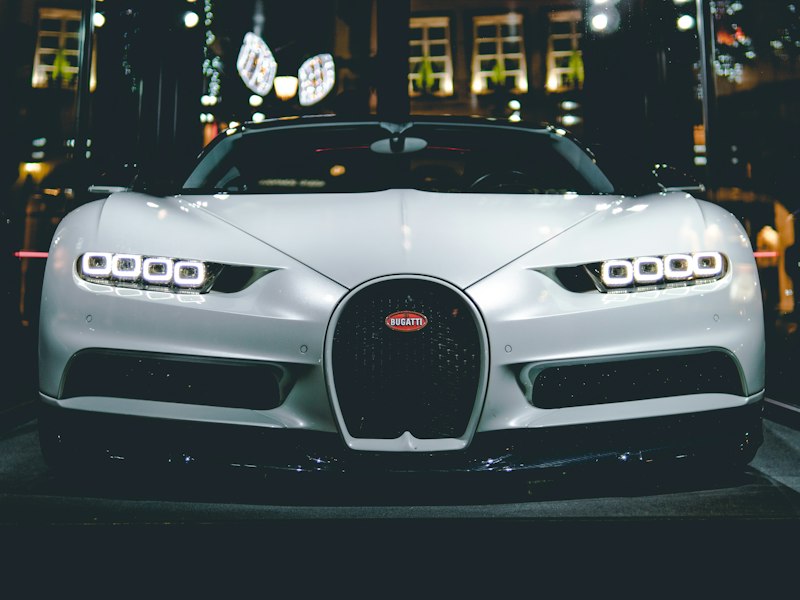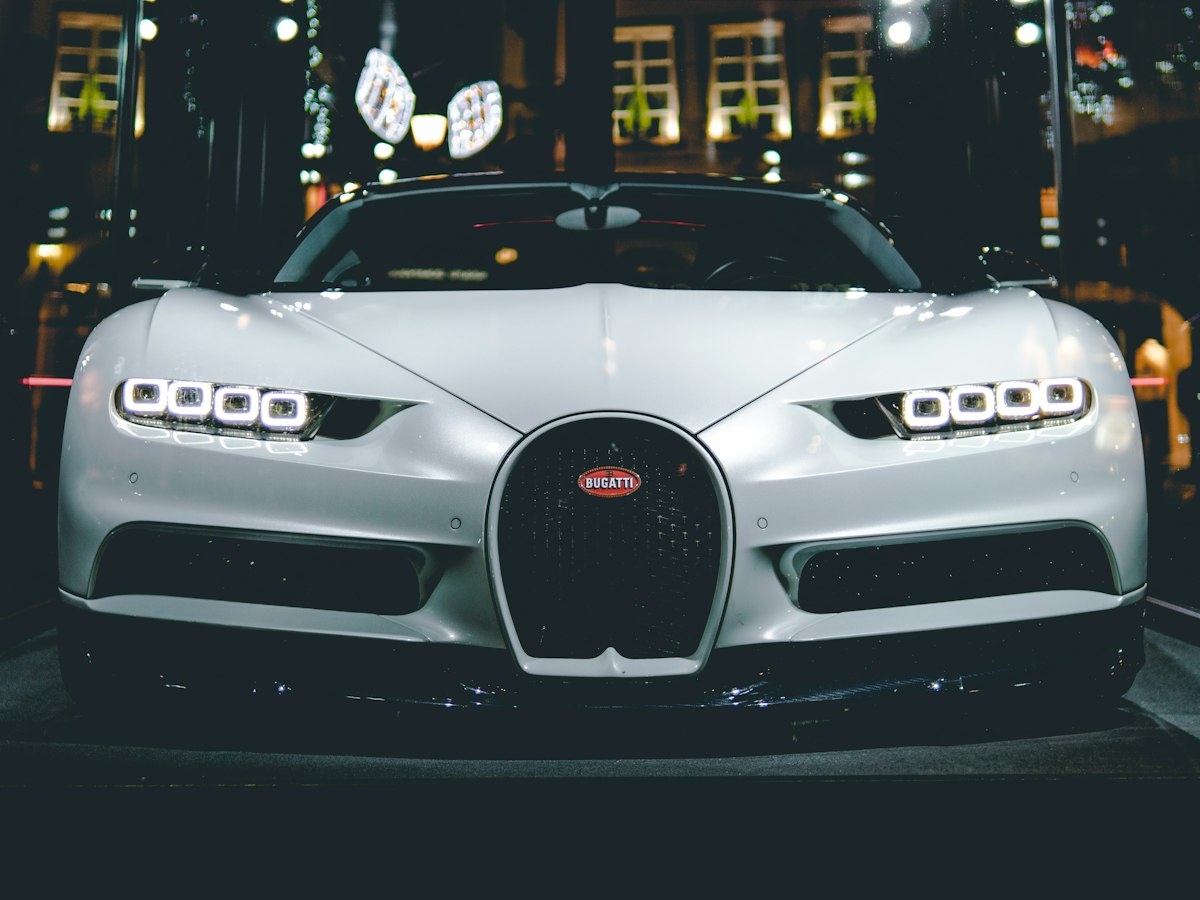
There is a moment, somewhere around 180 miles per hour on the back straight of the Nardo Technical Center in southern Italy, where the Bugatti Tourbillon stops feeling like a car and starts feeling like something else entirely. Not an aircraft, exactly — the sensory input is too visceral, too connected to the road surface for that comparison. Not a roller coaster, either — you are in control, or at least you believe you are. It is something closer to controlled teleportation: a sensation of being hurled through space with such precision and such violence that your brain struggles to reconcile the speed with the smoothness.
This is the Bugatti Tourbillon, and it is, without qualification or caveat, the most extraordinary automobile I have ever driven.
The Numbers That Define It
Let us begin with the specification, because the specification is staggering. At the heart of the Tourbillon sits an 8.3-liter naturally aspirated V16 engine — the first production V16 since the Cadillac V-16 of the 1930s, and the first ever designed specifically for a mid-engine hypercar. This engine alone produces 1,000 horsepower at 9,000 rpm, with a redline of 9,500 rpm that produces a sound so extraordinary it deserves its own paragraph (we will get to that).
Supplementing the V16 are three electric motors — one on the rear axle integrated with the eight-speed dual-clutch transmission, and two on the front axle providing torque vectoring and all-wheel drive capability. Combined system output is 1,800 horsepower and 1,180 lb-ft of torque. The 25-kWh battery pack, developed in partnership with Rimac, provides approximately 37 miles of pure electric range and sits within the monocoque structure for optimal weight distribution.
The result is a car that weighs 1,995 kilograms — heavy by hypercar standards, but light for what it contains — and accelerates from 0 to 60 mph in 2.0 seconds flat. The 0-to-124-mph sprint takes 5.4 seconds. The top speed, which Bugatti claims has been validated at their Ehra-Lessien test facility but which I was understandably not invited to attempt, is 277 mph. That number would make the Tourbillon the fastest production car ever built.
The price: $3.99 million before options. Total production: 250 units. The waiting list, according to Bugatti, was oversubscribed before the car was even publicly announced.
The Engine: An Ode to Internal Combustion
In an era where most manufacturers are pivoting to full electrification, Bugatti's decision to develop an entirely new naturally aspirated V16 is either an act of magnificent defiance or inspired madness. Having experienced the result, I am inclined to call it genius.
The engine was developed by Cosworth in collaboration with Bugatti's in-house engineering team in Molsheim, France. It uses a flat-plane crankshaft — unusual for a V16 — which gives the engine a character completely unlike the W16 that powered the Veyron and Chiron before it. Where the W16 was a force of nature, producing its power in a smooth, relentless tsunami of torque, the V16 is a different animal. It builds. It climbs. It has a rev range that rewards exploration, with a distinct change in character above 6,000 rpm where the engine seems to shed its skin and become something feral.
"We wanted the Tourbillon to have a soul. Electric motors are incredible for performance, but they are silent and linear. The V16 gives this car a heartbeat, a voice, a personality. When you hear it at 9,000 rpm, you understand why we spent four years developing it." — Mate Rimac, CEO of Bugatti-Rimac
And the sound. The sound. It enters the cabin at around 4,000 rpm as a deep, mechanical hum — the kind of noise that suggests immense forces at work beneath you. By 6,500 rpm, it has transformed into a bark, aggressive and sharp, with individual combustion events almost discernible to the ear. And above 8,000 rpm, the V16 produces a wail that sits somewhere between a Formula 1 car of the V10 era and something entirely its own. It is not loud in the obnoxious, look-at-me sense. It is loud in the way a symphony orchestra is loud at its crescendo — structured, layered, and deeply emotional.
I am not ashamed to say it gave me goosebumps. Twice.
Behind the Wheel
Bugatti provided access to the Tourbillon for one day at the Nardo ring and the attached handling circuit. The conditions were ideal: 14 degrees Celsius, dry track, light wind. Two prototype-specification cars were available, both finished in Atlantic Blue with the optional exposed carbon-fiber body panels that add $85,000 to the base price.
The first thing you notice when you climb into the Tourbillon is the driving position. It is lower than the Chiron's — significantly lower — and more reclined, placing your hips close to the ground in a manner that immediately communicates the car's mid-engine layout. The steering wheel is smaller than expected, wrapped in hand-stitched leather with minimal buttons. Bugatti's philosophy here is clear: the driver should focus on driving, not on toggling through menus.
At low speeds on the access road to the circuit, the Tourbillon is surprisingly civilized. In its most relaxed driving mode, the electric motors handle propulsion entirely, and the car glides along with the refinement of a luxury sedan. The ride quality, despite the carbon-ceramic brakes and the massive 285/30 R21 front and 355/25 R22 rear Michelin Pilot Sport Cup 3 tires, is genuinely comfortable. The adaptive dampers, which use a 48-volt active system, read the road surface with uncanny precision.
But you do not spend $4 million for refinement. You spend it for what happens when you press the right pedal to the floor.
The acceleration is, frankly, difficult to describe to someone who has not experienced it. I have driven the Chiron Super Sport. I have driven the Rimac Nevera. I have driven McLarens and Ferraris and Lamborghinis at speeds that would have my insurance company reaching for the cancellation forms. Nothing — nothing — prepared me for the Tourbillon at full throttle with the V16 engaged.
The initial hit comes from the electric motors, which deliver their torque instantaneously. You feel the car lunge forward, pressing you deep into the seat. Then, perhaps half a second later, the V16 catches up and adds its own thousand horsepower to the equation, and the acceleration goes from violent to otherworldly. The horizon rushes toward you. The peripheral vision blurs. The speedometer — a physical, jeweled dial inspired by haute horlogerie — sweeps past numbers that should not be possible on a public road-legal automobile.
The Interior: Where Watchmaking Meets Automotive Design
This brings us to perhaps the Tourbillon's most talked-about feature: its dashboard. In a departure from the industry-wide trend toward large digital screens, Bugatti has partnered with Swiss watchmakers to create an instrument cluster that is, quite literally, a mechanical timepiece scaled up to automotive proportions.
The speedometer, tachometer, and secondary gauges are all analog, driven by a combination of mechanical movements and precision stepper motors. The faces are made from sapphire crystal. The bezels are machined from solid titanium. The numerals are hand-applied in a process that takes a single technician approximately 14 hours per dashboard. The effect is breathtaking — it looks and feels like you are driving a $400,000 watch that happens to have 1,800 horsepower.
Bugatti says the dashboard alone contains 672 individual components, many of them manufactured by the same Swiss suppliers who produce movements for Patek Philippe and Audemars Piguet. It is, almost certainly, the most expensive instrument cluster ever fitted to a production automobile. And it is worth every cent. In a world of touchscreens and software updates, there is something profoundly satisfying about a tachometer needle that moves with the physical precision of a Swiss chronograph.
The rest of the interior is finished to a standard that makes Rolls-Royce look pedestrian. The leather is sourced from a single Scottish tannery and is available in 58 colors. The aluminum switchgear is machined, anodized, and diamond-knurled. The air vents are jewel-like in their construction. Even the seatbelt buckles have been redesigned — they click into place with a mechanical precision that is deeply satisfying.
On the Handling Circuit
If the Nardo ring showcased the Tourbillon's straight-line supremacy, the handling circuit revealed its dynamic breadth. The car weighs nearly two tonnes, and you can feel that mass in the initial turn-in phase. But the front-axle electric motors, which can independently vary torque to each front wheel, provide a level of turn-in response that belies the car's weight. Point the steering wheel, and the nose goes where you tell it. There is no understeer push, no vague dead zone on center. The steering itself is electro-hydraulic — a deliberate choice over full electric assistance — and it feeds back information about the road surface with a clarity that modern hypercars rarely achieve.
The mid-corner balance is extraordinary. With the V16 mounted longitudinally behind the cabin and the battery pack integrated into the carbon monocoque, the weight distribution is 42/58 front-to-rear, and the car rotates around its center of gravity with a fluidity that borders on telepathic. In the faster sweeps, where confidence in the front end is paramount, the Tourbillon is unshakable. In the tighter hairpins, a gentle lift of the throttle brings the rear around with a progressiveness that invites you to explore the limits rather than fear them.
The brakes, too, deserve special mention. The carbon-ceramic discs measure 440mm at the front and 410mm at the rear, clamped by ten-piston front and six-piston rear calipers. The pedal feel is firm, progressive, and perfectly calibrated. From 200 mph, the stopping distances are simply extraordinary — the car sheds speed with an urgency that is almost as impressive as its ability to build it.
How It Compares to the Chiron
The Chiron was, and remains, one of the defining automobiles of its generation. It took the blueprint established by the Veyron and refined it into something more livable, more dynamic, and faster in every measurable way. But the Tourbillon is not merely an evolution of the Chiron. It is a reinvention.
Where the Chiron relied on a quad-turbocharged W16 for its performance, the Tourbillon's naturally aspirated V16 and hybrid system deliver more power with a dramatically different character. Where the Chiron's interior was luxurious but conventionally digital, the Tourbillon's watchmaking-inspired dashboard is a statement of artistic intent. Where the Chiron was built on a steel and carbon-fiber structure, the Tourbillon uses a full carbon-fiber monocoque with integrated battery housing, resulting in a stiffer, lighter platform despite the added hybrid components.
The Chiron was a great car. The Tourbillon is something beyond that — a machine that exists at the intersection of art, engineering, and sheer ambition.
The Verdict
The Bugatti Tourbillon costs $3.99 million. It is limited to 250 examples, all of which are already spoken for. It is, by any rational measure, an absurd automobile — too fast for any public road, too expensive for any rational purchase decision, and too powerful for anyone who lacks professional driving training to fully exploit.
And yet, it is also one of the most important cars of this decade. It proves that the internal combustion engine, far from being a relic of the past, can still form the emotional core of an automobile even as electrification provides the performance envelope. It demonstrates that craftsmanship and artisanship still have a place in an industry increasingly dominated by software and screens. And it establishes, beyond any doubt, that the Bugatti name — now under the stewardship of Mate Rimac and his team — is in the safest possible hands.
I was given one day with the Tourbillon. It was not enough. It will never be enough. This is a car that deserves to be driven and driven and driven until the tires are gone and the brakes are glowing and the V16 has sung its aria at 9,000 rpm one final, glorious time. It is not just the best Bugatti ever made. It is, I believe, the finest expression of the hypercar art form that the automotive industry has yet produced.
The Bugatti Tourbillon does not rewrite the rules. It writes entirely new ones.